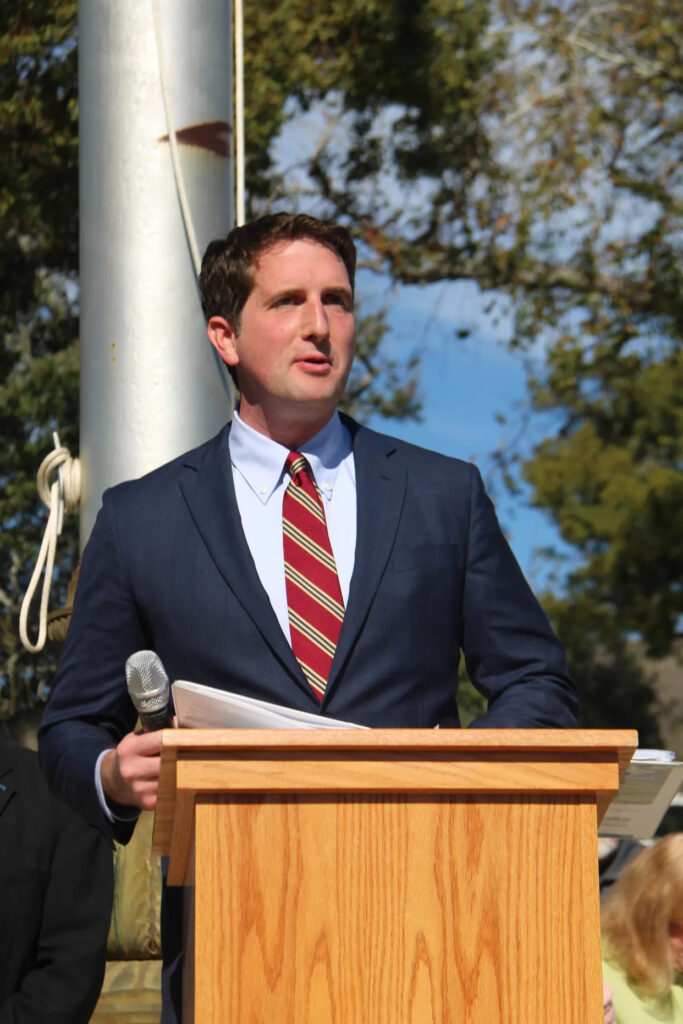
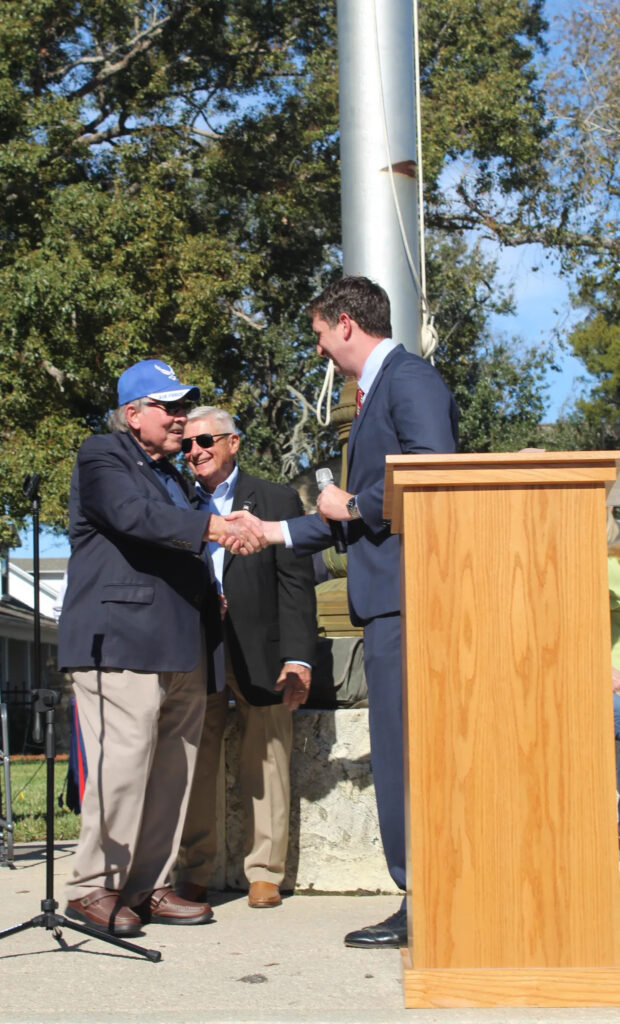
 On Saturday, December 13, Clerk Patty gave a keynote ahead of the wreath laying ceremony at the St. Augustine National Cemetery. His words are below.
We gather today on sacred ground.
Look around you at these weathered stones, these markers that stand as silent sentinels over hallowed earth. We stand in St. Augustine National Cemetery, one of the oldest national cemeteries in our country. It is a place where the very soil beneath our feet has absorbed the blood, sweat, and tears of those who gave everything so that we might stand here free.
On this National Wreaths Across America Day, we come together not merely as residents of a community, but as guardians of memory, as keepers of stories that must never be forgotten. As a grateful people who understand that freedom is never free, it is purchased with the lives of the brave.
Today, we fulfill a sacred duty. We place wreaths. We speak names. We remember.
The mission of Wreaths Across America is beautifully simple, yet profoundly powerful. It rests on three pillars: Remember, Honor, and Teach.
To remember is to refuse to let the fallen fade into the mists of time. It is to say their names aloud, to tell their stories, to ensure that their sacrifice echoes through generations. When we remember, we acknowledge that each marker here represents not just a soldier, but a son or daughter, a brother or sister, a husband or wife, a father or mother.
In our modern world, where news cycles change by the hour and yesterday’s headlines are forgotten by tomorrow, remembering is a revolutionary act. It is a declaration that some things are too important to forget, that some debts can never be fully repaid, only honored through faithful memory.
To honor is to recognize the magnitude of sacrifice. It is to stand in awe of courage that defies comprehension. The men and women who rest here in St. Augustine National Cemetery, who faced dangers we can scarcely imagine, they deserve our honor. Not just today, but every day.
Perhaps most importantly, we must teach. We must pass these stories to our children and grandchildren. We must ensure that future generations understand the cost of liberty. In an age where many young people have never known a family member who served, where military service can seem distant and abstract, teaching becomes essential.
When we teach, we build a bridge between past and present, between the fallen and the living, between sacrifice and gratitude. This cemetery where we stand is itself a teacher. Established in 1828, it predates the Civil War, the great conflicts of the twentieth century, and the modern American military as we know it.
This is a place where layers of American history converge in a small, solemn space. To walk among these graves is to walk through American history itself, to touch the very foundation upon which our nation was built. And yet, how many people pass by without stopping? How many drive past without knowing what lies within these gates? That is why we are here today.
It’s common in our country to see someone in uniform, or to meet a veteran, and say, “Thank you for your service.” It’s a phrase we’ve all heard, a phrase many of us have spoken. But if you’ve ever said or heard those words, you may have noticed something: the person receiving that thanks often doesn’t quite know how to respond. They may pause, nod, or give a quiet “thank you” in return.
Many servicemembers and veterans feel uncomfortable with the recognition, unsure of what to say, uncertain whether their service truly warrants such gratitude.
The best response I’ve ever heard to “Thank you for your service” comes from a young Marine named Kyle Carpenter. On November 21, 2010, in Marjah, Afghanistan, Lance Corporal Kyle Carpenter was stationed on a rooftop with a fellow Marine when a grenade landed between them. In that split second, that fraction of a moment when most of us would freeze, or instinct would scream at us to run, Kyle Carpenter made a choice. He threw himself on the grenade.
The explosion was devastating. Carpenter’s body absorbed the blast meant for his fellow Marine. His face was shattered. He lost his right eye. His skull was fractured. His arm was mangled. He sustained injuries so severe that he was initially declared “P.E.A.”—patient expired on arrival.
But Kyle Carpenter didn’t die that day. Through dozens of surgeries, through years of painful recovery, through determination, he survived. And in 2014, President Obama placed the Medal of Honor around his neck, making him the youngest living recipient of our nation’s highest military decoration.
When people approach Kyle Carpenter and say, “Thank you for your service,” do you know how he responds? He looks them in the eye and says, “You’re worth it.” Let those three words sink in.
A young man who sacrificed his body, who endured unimaginable pain, he looks at his fellow Americans and says, “You’re worth it.”
America is built on sacrifice. We know this. We celebrate the grand sacrifices, the Medal of Honor recipients, the soldiers who stormed beaches and held lines against impossible odds. But America is also built on the sacrifices of ordinary people.
The firefighter who runs into the burning building. The police officer who protects the innocent. The teacher who stays late to help a struggling student. The volunteer who gives their time to make their neighborhood a better place.
These are daily decisions to put others first, and contribute to something larger than oneself. And they build the fabric of our community. Both you and I are worth those sacrifices. America is worth it. The idea that we can live in freedom, and pursue our dreams in peace, that idea is worth sacrificing for.
To the veterans in attendance today, I want to speak directly to you for a moment. You may not have thrown yourself on a grenade like Kyle Carpenter. You may not have a Medal of Honor hanging in your home. You may feel that your service was ordinary, that you were just doing your job. But let me tell you something: There is no such thing as ordinary service.
Every person who raises their right hand and takes the oath to support and defend the Constitution of the United States against all enemies, foreign and domestic, is extraordinary. Every person who puts on the uniform, who leaves their family, who stands ready to make the ultimate sacrifice, that person is a hero.
And on behalf of a grateful community, on behalf of a grateful nation, I want to say to you what Kyle Carpenter says: You’re worth it. Thank you for your service. Thank you for your sacrifice.
In a few moments, we will begin placing wreaths on the graves in this cemetery. Each wreath is more than a decoration. It is a promise. It is a symbol of remembrance. It is a living tribute to those who have died. As we place these wreaths, I encourage you to pause at each grave. Read the name if you can. Say it aloud. Think about the person. Imagine their life, their service, their sacrifice.
And imagine this: If that soldier could speak to you today, if you could look them in the eye and say, “Thank you for your service,” what would they say back? I believe they might say what Kyle Carpenter said. I believe they might look at you and say: “You’re worth it.”
They believed in something bigger than themselves. They believed in us. For those graves that bear no name, for the unknown soldiers who rest here, place your wreath with even greater reverence. They gave not only their lives but their very identity. They are known only to God, but they are not forgotten by us.
The soldiers who rest here in St. Augustine National Cemetery cannot tell their stories. We must tell them. They cannot ensure they are remembered. We must remember them.
This is our duty. This is our honor. This is our sacred trust.
Thank you.
Brandon J. Patty
Clerk of the Circuit Court and County Comptroller
St. Johns County
